.png)

Designing an AI-powered health assistant for Bupa telehealth's chronic health program
Scope of work
GenAI product design
Discovery & dual-track research
User experience (UX)
User interface (UI)
Usability testing
Co-design & facilitation
Feature definition & prioritisation
Agile delivery
Company
Bupa
Year
2025
My role
Product design lead
What started as a hackathon pitch became a full product and one of Bupa's key strategic initiatives in personalised health
Bupa's global leadership challenged employees worldwide: how can AI be used as a supporting tool to enable faster, better healthcare?
Our team took that challenge back to the drawing board, framed a real problem, identified a use case, built a concept, pitched it, and won the internal global hackathon. As winners, we had the opportunity to collaborate with Microsoft's Innovation Hub, working alongside their engineering and solution architecture teams to validate and accelerate our idea. This AI health assistant is now in pilot for Bupa's telehealth programs and in pipeline to launch at scale in Blua, Bupa's main consumer health app.
The gap between appointments is where care usually breaks down
Up to 80% of what patients hear from their doctor is forgotten almost immediately. For people managing chronic conditions, that gap is where care plans go unfollowed and progress stalls. Additionally, health data is scattered across hospitals and providers, which means most patients are now left to advocate for themselves with no centralised record of their own history.
How might we help people managing chronic conditions own their health journey so they remember what was said, understand what to do, and actually act on the guidance they receive?


Leading design across the full product lifecycle
As the project's lead designer, I worked end-to-end across the initiative. I was responsible for:
-
Leading product design from discovery through to pilot launch
-
Running dual-track research with patients and clinicians, translating findings into product requirements and features
-
Designing two connected platforms, a health coach portal and patient-facing app through to build-ready handoff
-
Facilitating co-design sessions with engineering, clinical SMEs, and product
-
Usability testing and iterative validation cycles

The brief said AI. I say, let's find the problem first.
Following our hackathon win and collaboration with Microsoft's Innovation Hub, we moved into in-depth discovery.
We ran parallel research tracks, conducting qualitative interviews with people managing chronic conditions to understand their jobs to be done, and separate concept-testing sessions with clinicians to understand their ways of working and attitudes towards AI-assisted tools.
Two things became clear early:
-
Patients needed continuity and clarity between appointments
-
Clinicians would only trust AI if they held full sign-off authority before anything reached a patient.
These two findings shaped the product architecture and became the foundation for every design decision that followed.

Research can only get you so far.
Find the right use case and test it live.
Discovery helped us understand patient and clinician behaviour and translate that into clear product requirements. We co-designed with clinicians, internal stakeholders, and engineers to ideate and prioritise feasible features.
But research can only tell you so much. The only way to get real feedback was to put a working product in front of customers. And because health is personal and confidential, we needed a controlled use case before committing to scale.
We found it within Bupa's Telehealth Chronic Disease Management Program, pairing members managing heart disease, diabetes, or post-surgery recovery with dedicated health coaches over 6 months. A natural fit for what we had designed.
From there we refined down to MVP scope, defined the human-in-the-loop architecture as a core product requirement, where the coach reviews and approves all AI-generated content before the member sees it, and developed key AI design principles to govern every design decision.

Test what matters, then build and ship
With the use case locked in, we ran a lean research sprint with the health coaches themselves to understand their program, workflows, and how they support members day to day. From there we co-designed the prioritised MVP feature set with coaches and engineers together.
A key part of this phase was testing the right prompt detail to generate accurate session summaries and a personalised health plan, capturing what was discussed and an organised checklist of goals and tasks. Not a to do list, but a living guide of specific actions such as walking 30 minutes a day or swapping white rice for brown.
Once aligned, we moved into polished designs ready for handoff and partnered with engineering through build, QA, and launch. The pilot launched with 20 members, with plans to scale to 1,300 members and a strategic decision to include the feature in Blua, Bupa's main consumer health app.

Phase 3: Iterative test, learn, refine
We ran structured test-and-learn cycles and co-design sessions wiwith messaging consultants and engineers to strengthen the AI’s reliability in real world conditions.
This included facilitating keyword-mapping and semantic workshops with consultants to improve accuracy and relevance. We captured synonymous language used in real customer conversations and mapped policy sections commonly referenced together, ensuring the AI could understand intent in context, not just keywords in isolation.
In parallel, we partnered closely with engineering to refine prompt strategy, establish guardrails for scope control, and structure content semantically to improve contextual accuracy.
Because OpenAI is a pre-trained model with no inherent Bupa context, this phase required deliberate knowledge and systems design. It was the critical step that transformed a promising proof of concept into a reliable MVP consultants could trust and use.
Meet the AI health assistant for better chronic management
Two connected platforms bridging Bupa members and their Telehealth coach, built around one principle: AI acts only as the assistant. This human-in-the-loop architecture means any AI-generated content is always reviewed and approved by the coach before it reaches the member, keeping clinical safety at the centre.

Telehealth coach portal
AI auto-generates a health summary and action plan from each consultation transcript.
The coach reviews, edits, and approves, and can enrich it further with additional resources like PDFs, links, recipe videos, or meal portion infographics. Only then does it reach the member via their portal.

Bupa member facing portal
A personalised daily view surfacing only the most relevant actions for today from exercises, meal / nutrition, and pre-appointment tasks.
Members access their approved consultation summaries and can ask the assistant questions about their plan.

Between session check-ins
With a 3 to 4 week gap between coaching sessions, we designed a lightweight check-in built into the app.
An email notification prompts people to review their health plan, where they tap through simple prompts, visual icon reactions and sliders, to rate their progress and flag how difficult tasks feel. There is also a space to leave a note for their coach so nothing important gets lost before the next session.


Following pilot success, the AI health assistant is scaling towards the expansion of Bupa's Blua consumer health app, with more features in scope including integration of wearable devices and smart health nudges for better preventative wellbeing.
1st
place at Bupa's global hackathon
Our team pitched a concept to address a real patient problem and won Bupa's internal global AI challenge.
20
members in the initial pilot
The assistant launched with 20 members in Bupa's Telehealth Chronic Disease Management Program, pairing people with dedicated health coaches over 6 months.
1,300+
members in scope for next rollout
Following a successful pilot, the feature is planned to scale across the full Chronic Disease Management Program.
$491
project benefit per member
Calculated cost benefit to the program per member supported, reflecting reduced claims risk and improved health management outcomes.
Impact from Pilot to Scale
What I learned from this project
Great product design is all about finding and connecting the dots together
It's okay to ship early if you can use it to learn fast
Waiting for the perfect build before testing means waiting too long. Imperfect prototypes in front of real users early taught us more than any workshop or usability testing.
Gaining user trust is a product requirement
Because this project uses AI, we needed to design for trust and communicate feature transparency at every step. It taught me that designing for trust is slower and more fragile than designing for usability — and in regulated contexts like health, it matters even more.
Understand the whole before designing any part
The clinician research and concept testing reshaped the entire product.
The best decisions came from considering all your primary users' perspectives simultaneously, not solving for one at a time.
Other work

Designing an AI agent for Bupa's consultants
Transforming consultant workflows with $1.02M impact

Transforming digital referral journeys at Bupa Dental
Optimising journeys to deliver $118k in new patient revenue
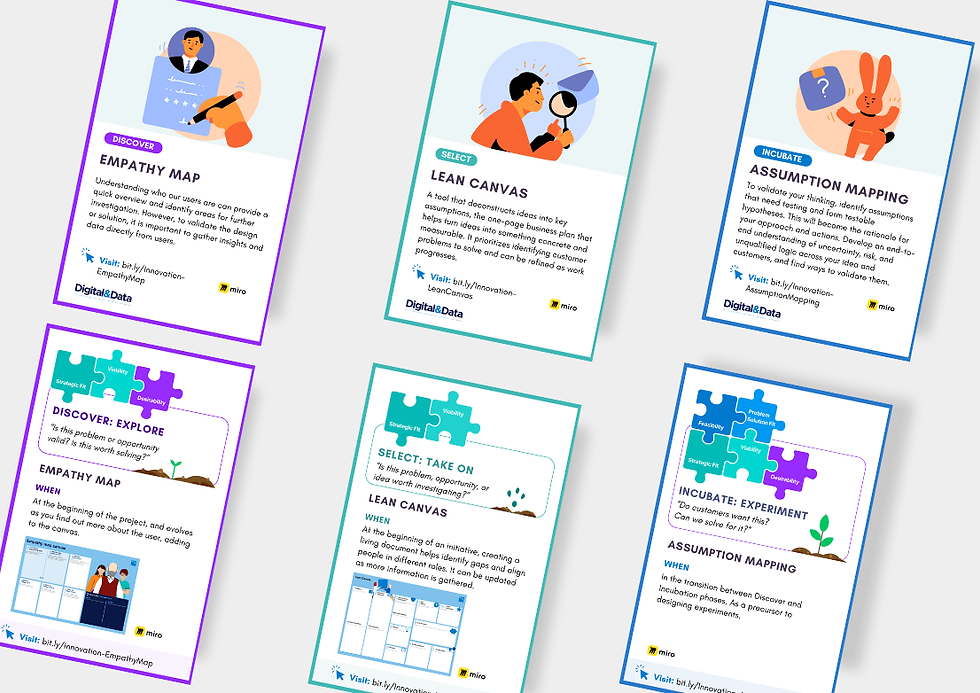
Design leadership in practice
Creating spaces, tools, and rituals that help design thinking spread beyond the design team.

.png)
Let's make something meaningful together
Made in sunny Radelaide!
© 2026 by Denise Tan